
Skin blackened by the flame, melting flesh with a smoky aroma: smoked aubergine (eggplant) is the base of several great classics of the Levant and the Mediterranean, such as moutabal and baba ganoush, as well as India’s baingan bharta. The secret is not a rare spice, but cooking directly over fire.
In this article, discover why aubergine is smoked, the steps to prepare it, the main dishes made from it, how to choose it and how to serve it.
On this page: Why smoke it? · The steps · Moutabal, baba ganoush and cousins · Choosing it · Serving it · 3-question quiz
Why smoke aubergine?
Placed directly on a flame, on embers or under a very hot grill, the aubergine cooks in its skin. The skin blackens and burns, while the protected flesh cooks in its own steam and takes on a smoky flavour. The skin is not eaten: it is removed after cooking.
This method gives a more fragrant and silkier flesh than gentle oven cooking. It also needs little fat during cooking: the olive oil is added afterwards, when seasoning.
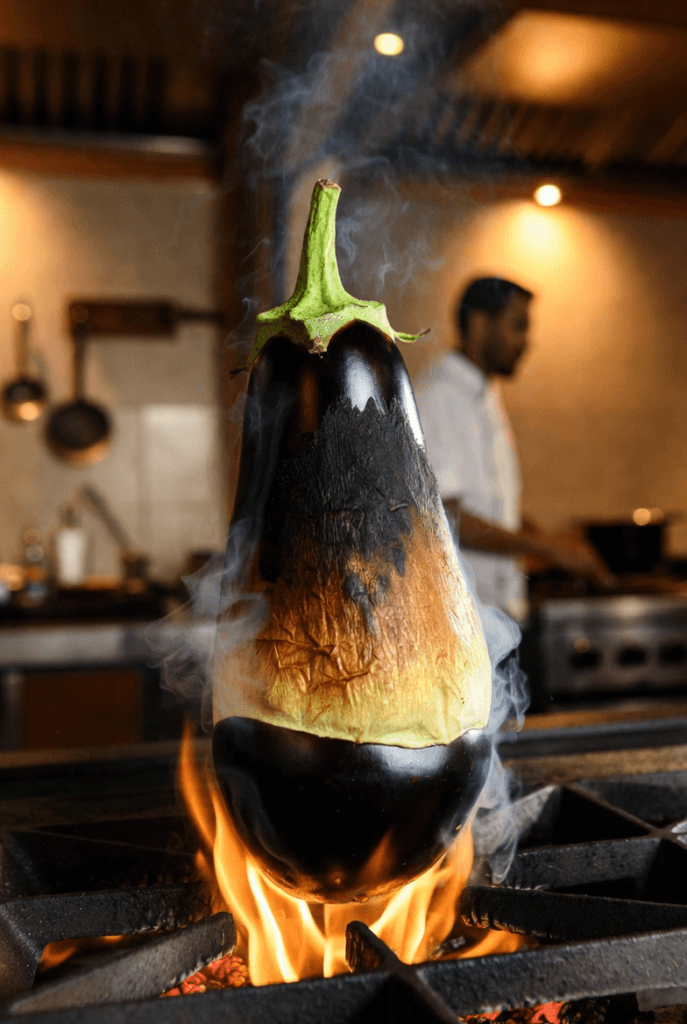
How to smoke an aubergine
Without exact quantities, here are the main steps:
- Prick the aubergine in a few places with a fork, so it does not burst.
- Place it on the flame of a burner, on embers or under the oven grill, and turn it regularly.
- Wait until it collapses: the skin should be blackened all over and the flesh very soft when pressed.
- Let it cool slightly, then remove the skin and scoop out the flesh, leaving any burnt pieces behind.
- Drain the flesh for a few minutes in a sieve, then mash it with a fork or chop it with a knife.
For a strongly smoky flavour, cooking over a flame or embers works best; in the oven, use the hottest grill setting possible.
Moutabal, baba ganoush and their cousins
Names vary between countries and families: the same name can refer to slightly different dishes from one region to another. Here are the most common landmarks:
| Dish | Origin | What sets it apart |
|---|---|---|
| Moutabal | Levant (Lebanon, Syria…) | Smoked flesh mixed with tahini, lemon and garlic; creamy texture |
| Baba ganoush | Levant | Depending on the country, close to moutabal, or a smoked aubergine salad with vegetables and herbs, sometimes with pomegranate |
| Aubergine caviar | Around the Mediterranean | Flesh mashed with olive oil, garlic and herbs, often without tahini |
| Baingan bharta | Northern India | Smoked flesh cooked with onion, tomato and spices; served hot, with Indian breads |
Choosing your aubergine
- Smooth, shiny, taut skin, without soft spots.
- A firm aubergine that feels heavy for its size.
- A bright green stalk, a sign of freshness.
- A medium size: very large or overripe aubergines often contain more seeds.
How to serve it
- In a selection of mezze, with hummus, falafel and warm pitta bread.
- With a drizzle of olive oil, parsley, a few pomegranate seeds or a pinch of paprika.
- Alongside grilled meats or roasted vegetables.
- To go further, read our article on moussaka, another great aubergine dish.
Test your knowledge
Three questions to recap the essentials. Your answers are not saved.
Mediterranean flavours in Isoraka
Quantum Isoraka welcomes you in Isoraka, Antananarivo, to share the flavours of the Mediterranean, the Levant and India. The dishes on the menu include homemade hummus and falafel; ask when you book about the dishes available during your visit.
Book a table at Quantum Isoraka.
