
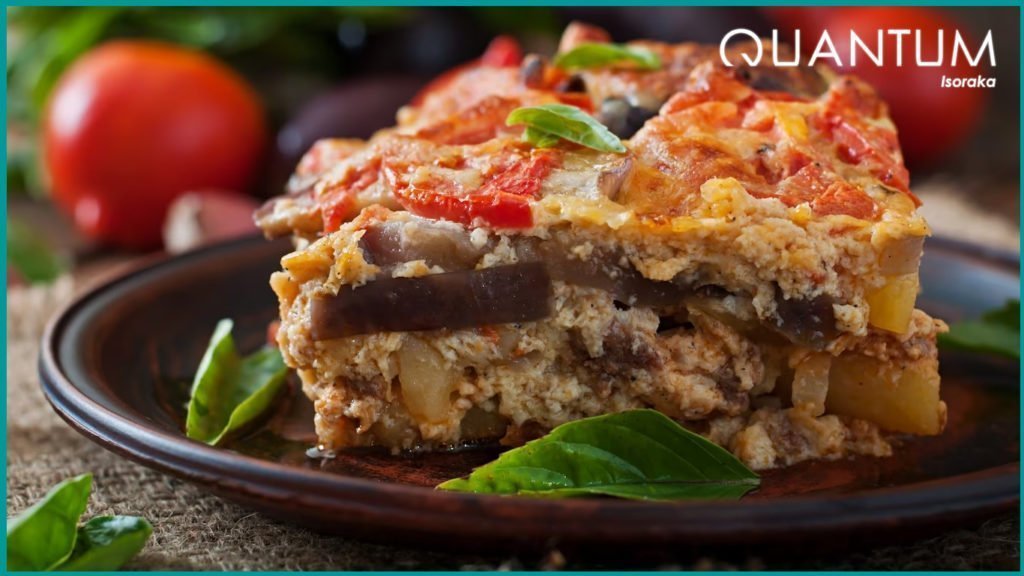
Melting aubergines, minced meat simmered with tomato and a béchamel browned in the oven: Greek moussaka is one of the most famous bakes of the Mediterranean. But behind the name lie other versions too, from the Balkans to the Middle East, sometimes without béchamel, sometimes without meat.
In this article, discover its origins, its main variations, its layers, the steps to prepare it and a few tips for serving it.
On this page: Origins · Variations · The layers · The steps · Serving it · 3-question quiz
Origins: a dish shared by several cuisines
Aubergine and meat dishes called moussaka, musakka or musaqa’a have long existed in the cuisines of the Balkans, Turkey and the Arab world. The name is often linked to an Arabic word evoking a dish served warm or cold.
The Greek version known today, with its thick layer of browned béchamel, was popularised in the 1920s by the Greek chef Nikolaos Tselementes, author of a reference cookbook. It has since become one of the symbols of Greek cuisine.
The main variations
| Version | Base | What sets it apart |
|---|---|---|
| Greek | Aubergines (sometimes potatoes), minced meat with tomato | Topped with béchamel and baked; served in slices |
| Turkish (musakka) | Aubergines and minced meat in tomato sauce | No béchamel, rather simmered; often served with rice |
| Levantine and Egyptian (musaqa’a) | Aubergines, tomatoes, onions, sometimes chickpeas or peppers | Often meatless, served warm or cold, as a mezze |
| Balkan | Potatoes and minced meat | Topped with an egg custard, sometimes with yoghurt |
The layers of Greek moussaka
- Aubergines: sliced, then grilled, roasted or fried before assembly.
- Meat sauce: minced lamb or beef, onion, garlic, tomato and mild spices such as cinnamon, allspice or oregano.
- Béchamel: butter, flour and milk, often enriched with egg yolk and grated cheese for browning.
- Optional: a first layer of sliced potatoes, which helps the slices hold together.
The preparation steps
Without exact quantities, here are the main steps:
- Prepare the aubergines: slice them, salt them if you wish, then grill or roast them in the oven.
- Cook the meat sauce: soften onion and garlic, add the meat, then the tomato and spices, and let it reduce.
- Make the béchamel, thick and smooth.
- Assemble the dish, alternating aubergines and sauce, then cover with béchamel.
- Bake until the top is well browned, then leave to rest before cutting.
Tips and serving
- Roasting the aubergines in the oven rather than frying them gives a moussaka with less fat.
- Resting time after baking gives clean slices that hold well.
- Serve it with a fresh salad, a yoghurt sauce and bread.
- To go further, read our articles on mutton and lamb and tchoutchouka.
Test your knowledge
Three questions to recap the essentials. Your answers are not saved.
Mediterranean flavours in Isoraka
Quantum Isoraka welcomes you in Isoraka, Antananarivo, to share the flavours of the Mediterranean, the Levant and India. The Mediterranean starters on the menu include a Greek salad; ask when you book about the dishes available during your visit.
Book a table at Quantum Isoraka.
